

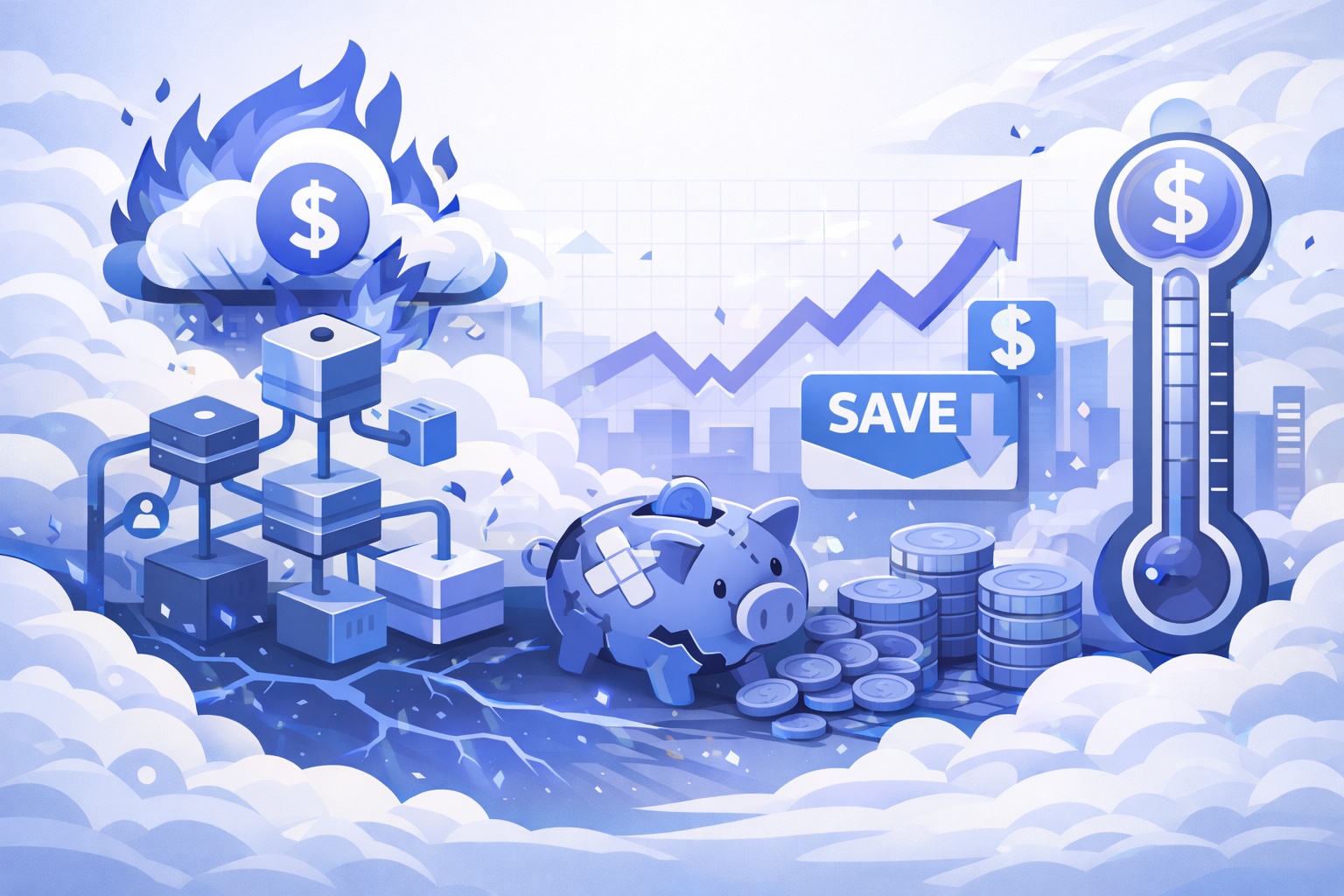
Every engineering leader has been there. You open the cloud bill. Your stomach drops. The number is 40% higher than last month.
The immediate panic sets in. Your CFO will ask questions. Your board wants answers. Someone suggests: "Let's buy a savings plan."
Within a week, you've locked in a commitment. The bill drops 25%. Everyone celebrates. Crisis averted.
But nothing actually got fixed.
The Economics Cloud Providers Don't Want You To Think About
Here's what most engineering leaders miss about savings plans and reserved instances: they're not designed to help you optimize. They're designed to lock in revenue for the cloud provider.
Think about it from the cloud provider's perspective. You just committed to spending $50,000 per month for the next year. That's $600,000 in guaranteed revenue. Your CFO gets to forecast. Their CFO gets to forecast. Everyone wins, right?
Wrong.
The cloud provider just turned your variable cost into their predictable cash flow. It's the same reason your gym offers annual memberships at a discount. They get paid upfront (or guaranteed monthly), and statistically, most people don't use what they paid for.
The cloud works the same way. AWS Savings Plans offer up to 72% off On-Demand pricing. Azure Reserved Instances promise up to 72% savings. Google Cloud Committed Use Discounts deliver up to 70% off standard rates.
These numbers look compelling. And they are - if you actually use what you commit to. But here's the problem: most engineering organizations don't.
Why Savings Plans Feel Like A Win (But Aren't)
When your cloud bill spikes and you're under pressure, buying a savings plan feels rational. It's quick. It's easy. The discount is immediate. Your bill drops, and you look like a hero.
This is exactly what the cloud providers want. From a pure cash flow perspective, savings plans are brilliant for them:
- Guaranteed revenue: You've locked in spend regardless of whether you use it. If your usage drops next quarter, they still get paid.
- Predictable forecasting: Wall Street loves predictable revenue. Your commitment helps their stock price.
- Reduced churn risk: You're locked in for 1-3 years. You're not switching providers anytime soon.
For you? The dynamics are different:
- Commitment without optimization: You've committed to paying for resources you might not need. The waste is still there, but you just paid less for it.
- False sense of security: Your bill went down, so everyone stops caring about efficiency. The fundamental problems, like overprovisioning, idle resources, and zombie workloads, remain unresolved.
- Reduced flexibility: Your architecture evolves. Your product changes. But you're stuck paying for commitments based on last month's usage patterns.
The Real Cost of "Cheap" Cloud Infrastructure
When you buy a Compute Savings Plan on AWS, you're committing to spend a fixed dollar amount per hour on compute. AWS applies that commitment to your lowest-cost compute usage first, giving you discounted rates.
Sounds great. But here's what actually happens:
Your team launches a new service. They set resource requests conservatively, at 2x what they expect to need, because no one gets fired for overprovisioning. The service runs fine. It uses 40% of the requested resources. However, your savings plan covers 100% of the commitment.
You've successfully reduced your unit cost while increasing your total waste.
As we explored in Kubernetes as an economic system, the fundamental problem isn't pricing. It's incentives. Engineers overprovision because the career risk of an outage is high and immediate. The cost of wasted infrastructure is low, and the impact is delayed. Savings plans don't change these incentives. They just make the waste cheaper.
The Hidden Trap: Commitment Without Visibility
Most engineering organizations buy savings plans based on current usage. Here's what typically happens:
Month 1: You commit to $50,000/month based on last month's usage. Bill drops 30%. Everyone's happy.
Month 3: Traffic grows. Usage increases to $65,000/month. Only $50,000 is covered. The remaining $15,000 is at full On-Demand rates. Your effective discount drops from 30% to 23%.
Month 6: You've optimized some workloads. Usage drops to $40,000/month. Great, right? Wrong. You're committed to $50,000. You're now paying for $10,000 of compute you're not using. As Azure documentation notes, reservation discounts are "use-it-or-lose-it."
Month 12: Your architecture has evolved. You've moved workloads to containers. You're using different instance types. But you're still committed to last year's pattern.
This is the trap. Savings plans require you to predict the future. But cloud infrastructure doesn't work that way.
What Savings Plans Actually Tell You
If buying a savings plan drops your bill by 30%, that tells you something important: you're consistently using enough compute that a commitment makes sense.
But it doesn't tell you whether you should be using that much compute.
If your baseline is $100,000/month and a savings plan drops it to $70,000/month, you saved $30,000. But what if 50% of that compute is wasted on overprovisioned resources and zombie workloads?
You just committed to paying $70,000/month for infrastructure you only need $35,000 of.
The discount is real. But the waste is also real - you just paid less for it. This is why optimizing your Kubernetes costs matters before you commit.
The Right Way To Think About Commitment Pricing
Savings plans and reserved instances aren't inherently bad. They're tools. Here's when they actually make sense:
After you've optimized: First, eliminate waste. Right-size your workloads. Fix overprovisioning. Then commit to your baseline usage. The discount applies to actual needs, not structural waste.
For predictable baseline load: If you have workloads that run consistently, such as databases, core services, and production infrastructure, those are candidates for commitment pricing. The keyword is predictable.
With clear attribution: Know which teams and services are consuming your commitment. This creates accountability. DevZero's cost monitoring features help with this.
When combined with dynamic resources: Use commitments for baseline capacity. Use On-Demand or Spot for variable load. This gives you predictability for steady-state usage and flexibility for spikes.
The cloud providers have extensive documentation:
But notice what they don't emphasize: optimization before commitment.
What To Do When Your Bill Is On Fire
If your cloud bill is spiking, here's the playbook:
Step 1: Buy the savings plan. Get the immediate relief. Your CFO needs to see the bill drop.
Step 2: Don't stop there. The savings plan bought you time. Use it to fix the underlying problems.
Step 3: Get visibility. Where is your money actually going? What workloads are most expensive? Check your EKS, GKE, or AKS pricing.
Step 4: Eliminate structural waste. Overprovisioned pods. Idle environments. Zombie workloads. Fix these systematically.
Step 5: Create feedback loops. Make cost visible to engineers at decision time. Show them the price of their resource requests. Make efficiency a metric that matters.
Step 6: Right-size your commitments. Once you've optimized, evaluate your commitment strategy based on actual needs, not inflated usage.
The Bottom Line
Savings plans and reserved instances are not cost optimization. They're cost mitigation. There's a difference.
Optimization means using fewer resources to accomplish the same work. Mitigation means paying less for the resources you're already using. Both matter. But one is fundamental, the other is financial engineering.
When your cloud bill spikes, buying a savings plan is the right tactical move. But strategic optimization and fixing the underlying inefficiency is what actually solves the problem.
The cloud made everything easier. Deploy faster. Scale faster. Ship faster. But that ease came with hidden costs. Layers of abstraction. Invisible waste. Incentives that reward overprovisioning.
Your infrastructure is running on an economic system that produces waste by design. Savings plans don't change this. They only offer a volume discount on waste.
Want to actually fix it? Start by understanding the economics. Build systems that make efficient behavior rational. Make costs visible. Create feedback loops. Align incentives.
The cloud isn't going to get cheaper on its own. But it can become more efficient if you treat it as the economic system it actually is.
Ready to move beyond band-aid solutions? Start by understanding which workloads waste the most resources in your clusters.
The goal isn't to pay less for waste. The goal is to eliminate waste at the source.