Best Kubernetes VPA Alternatives for Production 2026
DevZero Team

If you want the short answer: the best Kubernetes VPA alternative for production is a tool that rightsizes CPU and memory on running pods without evicting them, works alongside HPA instead of fighting it, and ties every change to real cloud cost.
Six platforms do this well in 2026. DevZero leads because it resizes and moves live workloads with zero restarts using checkpoint-restore, followed by ScaleOps, Cast AI, StormForge, PerfectScale, and Sedai. The rest of this guide explains why teams leave the native Vertical Pod Autoscaler, what to look for in a replacement, and how each option actually behaves in production.
Looking for how VPA itself works? This page is about replacing it. For the mechanics — update modes, the three VPA components, YAML examples, and where in-place resize fits — read Kubernetes VPA: Rightsize Pod Resource Requests instead.
Why do teams look for a VPA alternative in the first place?#
The Vertical Pod Autoscaler was a good idea that ran into a hard wall in production. It watches how much CPU and memory your pods actually use, then recommends better resource requests and limits so you stop paying for capacity you never touch.
The problem is what happens when VPA tries to apply those recommendations. To change a pod's resources, a classic VPA must evict and restart it. For a stateless web server, that is a minor blip.
For a database, a JVM service holding a warm cache, or a machine learning job three hours into a run, a restart is expensive and sometimes dangerous.
There are three more reasons VPA gets shelved:
- It conflicts with HPA. If both CPU and memory targets are on the same workload, Kubernetes doesn’t resolve the conflict. You get unpredictable scaling behavior, so most teams are told to never run them together on the same metric.
- It is blind to everything except history. VPA only looks at past CPU and memory usage. It does not see request rate, latency, queue depth, or cost. For bursty or latency-sensitive workloads, usage is a poor stand-in for real demand.
- It has no idea what anything costs. VPA can lower a request without any awareness of node bin-packing or your cloud bill, so the savings you expect often do not show up on the invoice.
When engineers ask about this out loud, the answers line up with the same short list. In a well-known LinkedIn thread, Robusta founder Natan Yellin asked for a good alternative to VPA for setting CPU and memory requests, and practitioners in the replies pointed to purpose-built rightsizing tools and pod-sizing recommenders rather than raw VPA.
The demand for something better than native VPA is not new, and it has only grown as clusters and cloud bills have.
The 2026 change that reshaped this whole question: in-place pod resize#
Here is the piece most experts miss, and it matters a lot.
For years, the single biggest knock on VPA was the restart requirement. In December 2025, Kubernetes v1.35 shipped In-Place Pod Resize as a stable, generally available feature. It first appeared as alpha in v1.27, moved to beta and on by default in v1.33, and reached GA in v1.35.
In simple terms, the CPU and memory of a running pod are now mutable. The kubelet writes the new values directly to the container's cgroup; the process keeps running, its ID doesn’t change, and the network namespace is preserved.
So does that mean native VPA is finally safe for production? Not quite, and this is the nuance worth understanding before you pick a tool.
VPA gained an InPlaceOrRecreate update mode that tries a non-disruptive in-place resize first and falls back to eviction if the node cannot honor the change. That mode has only reached beta, and it still carries real limitations in practice.
Three things still bite:
- In-place resize is best effort, not guaranteed. If the node lacks capacity for the new size, VPA falls back to the old evict-and-recreate path. For a poorly provisioned cluster, that fallback fires often.
- Memory changes often still restart the container. Many runtimes, especially the JVM, read their memory ceiling once at startup. Growing the cgroup does not help a JVM launched with a fixed heap, so those workloads need resizePolicy: RestartContainer for memory, which brings the restart back.
- VPA still only sees CPU and memory history. In-place resize removed the restart pain, but it did nothing about VPA's blindness to cost, latency, and scheduling.
The takeaway: In-place resize made the whole category better, but it didn’t turn native VPA into a finished production tool. It raised the floor. The tools below build on that floor and add the parts VPA still lacks: real-time decisions, cost awareness, safe migration, and scheduling intelligence.
Quick comparison of the six tools#
| Tool | Applies changes without restart | Cost-aware scheduling | GPU / AI focus | Live migration | Best fit |
|---|---|---|---|---|---|
| DevZero | Yes, live rightsizing | Yes, 3,000+ instance types | Yes, built-in | Yes, checkpoint-restore | Production, stateful, and GPU |
| ScaleOps | In-place capable | Partial | Limited | No | Hands-off pod rightsizing |
| Cast AI | Partial, constrained | Yes, node level | Some | Limited | Node and spot optimization |
| StormForge | Yes, with fallback | Bill-accurate via CloudBolt | Limited | No | HPA harmony at scale |
| PerfectScale | In-place capable | Partial | Limited | No | Reliability-first teams |
| Sedai | Yes, cautious | Partial | Limited | No | Mixed infrastructure |
Now, Let’s see each of them in more detail here.
The 6 best Kubernetes VPA alternatives for production in 2026#
Here’s the list of all the top alternatives. Check each one and map it to the table below to find your best fit.
1. DevZero#
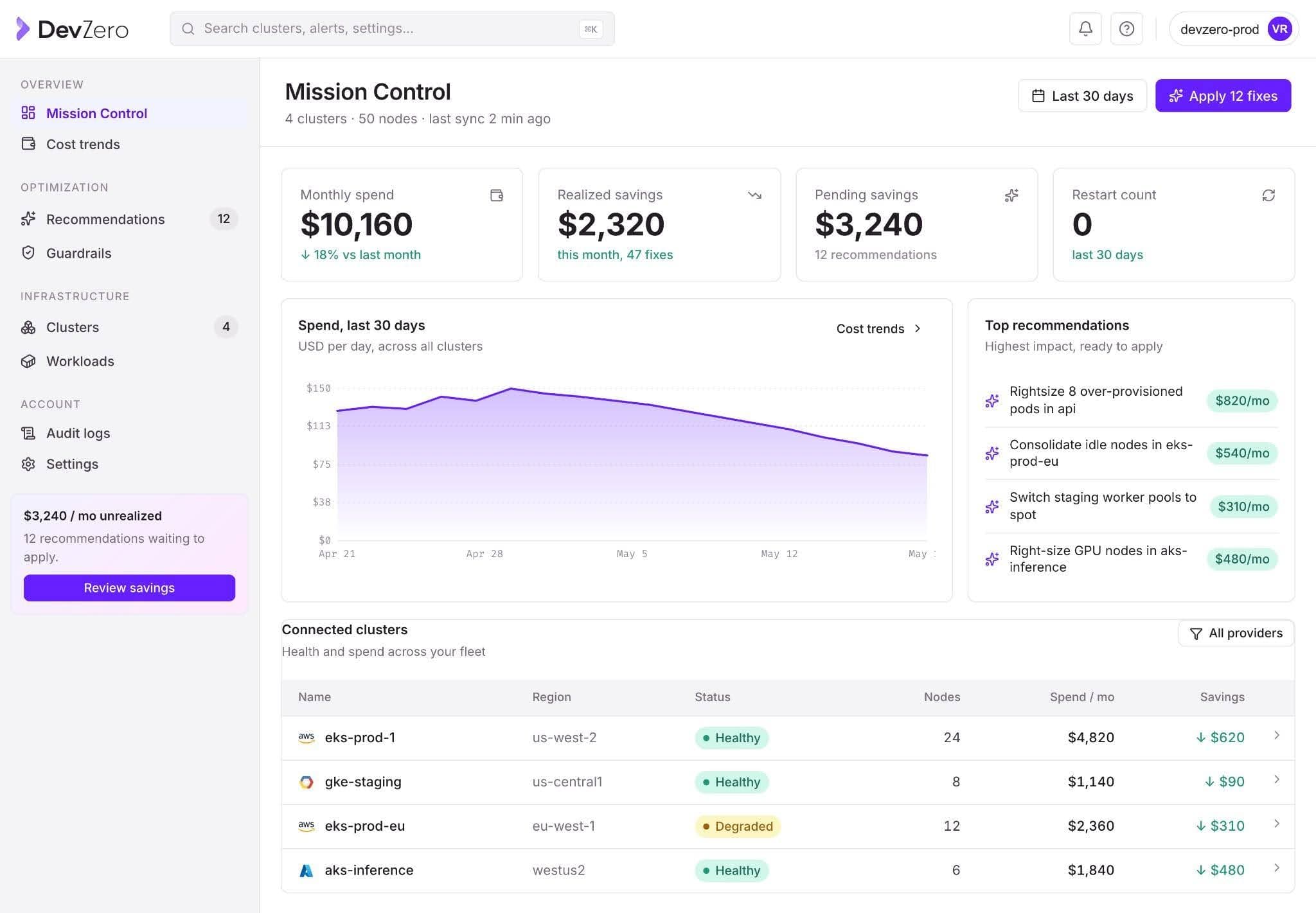
Best for: Production teams, stateful services, and AI or GPU workloads that cannot tolerate a restart.
DevZero is an autonomous Kubernetes optimization platform that profiles, schedules, and rightsizes workloads in real time without restarting them. It was founded in 2022 by former Uber engineers Debo Ray and Rob Fletcher, who hit the same overprovisioning problem every Kubernetes operator faces and built their own tooling to solve it.
Where VPA has to evict a pod to change its size, DevZero adjusts CPU and memory on running pods directly, with no eviction and no downtime.
It goes one step further with checkpoint-restore. When a workload needs to move because of a demand shift, a spot interruption, or an infrastructure disruption, DevZero snapshots the running workload and live migrates it to new compute instantly, without a restart.
A TechDay editor covering the platform noted that this checkpoint-restore technology is what sets DevZero apart, as it enables live migration of workloads during demand shifts or infrastructure disruptions.
It is the only tool in this list where moving a workload doesn’t mean restarting it.
This is the exact gap VPA leaves open. If your main reason for wanting a VPA alternative is that restarts are unacceptable, this is the direct fix. Book a demo and watch a stateful workload get resized live.
Here’s how they do it: DevZero uses XGBoost forecasting to predict future resource needs, which avoids the inflated baselines you get when a workload spikes at startup. You can set optimization per cluster, node pool, or workload, choosing a steady statistical mode or a more aggressive predictive mode.
It also picks the lowest-cost instance that still holds performance by monitoring more than 3,000 instance types and 69,000 price points across 80-plus regions on AWS, Azure, GCP, OCI, and OpenShift.
A real example makes the difference concrete: Personality Pool, an HR-tech startup on AWS, was running its EKS cluster at 15 percent utilization, which means it was paying for roughly nine times the compute it actually used. The DevOps lead installed DevZero's read-only operator in under a minute, and within hours, the team had cost visibility it never had before.
They started applying recommendations on day five, daily spend dropped 30 percent within 24 hours, and total savings reached 60 percent by day 30, with no change to application architecture and no performance loss.
Importantly, DevZero doesn’t ask you to throw out Karpenter, HPA, VPA, or KEDA. It works alongside them and fills the layer they do not cover: workload-level intelligence and live migration.
Strengths
- Live rightsizing of CPU and memory on running pods, no evictions
- Checkpoint-restore for live migration without restarts, unique in this list
- GPU and inference optimization built in, covering 23-plus GPU models
- Cost-aware scheduling across 3,000-plus instance types and multi-cloud
- Read-only operator installs in under a minute, so you can verify before you trust
Trade-offs
- Newer entrant, so the integration ecosystem and docs are still growing
- Smaller community footprint than older tools
You can install the read-only operator and see your own numbers in 24 hours. Run the free assessment on one cluster and compare it to your current bill.
2. ScaleOps#
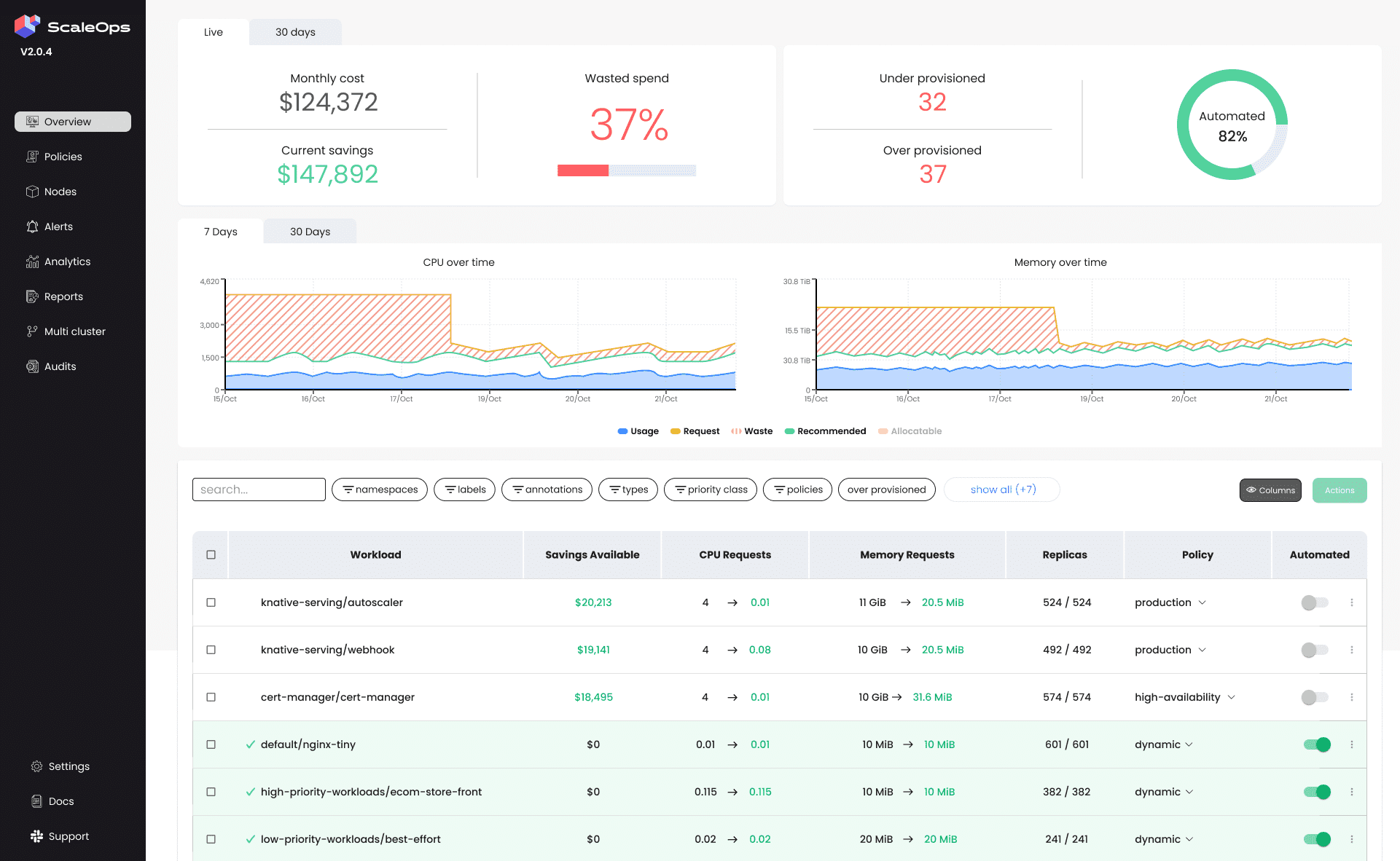
Best for: Teams that want automated pod rightsizing with minimal ongoing configuration.
ScaleOps takes a machine learning approach to resource management, continuously analyzing workload patterns and adjusting requests and limits automatically.
Its strength is the degree of automation. Many teams can set it and let it run, and it is well regarded by people who find VPA too blunt and HPA too reactive and want something smarter in between. It integrates with HPA and adds automated tuning that goes beyond standard VP offers.
Strengths
- Strong ML-driven rightsizing that adapts to workload patterns over time
- Automated HPA tuning that cuts manual configuration
- Low-friction deployment that does not require major cluster changes
Trade-offs
- No live migration or checkpoint-restore capability
- Node-level provisioning and bin-packing are not core strengths
3. Cast AI#
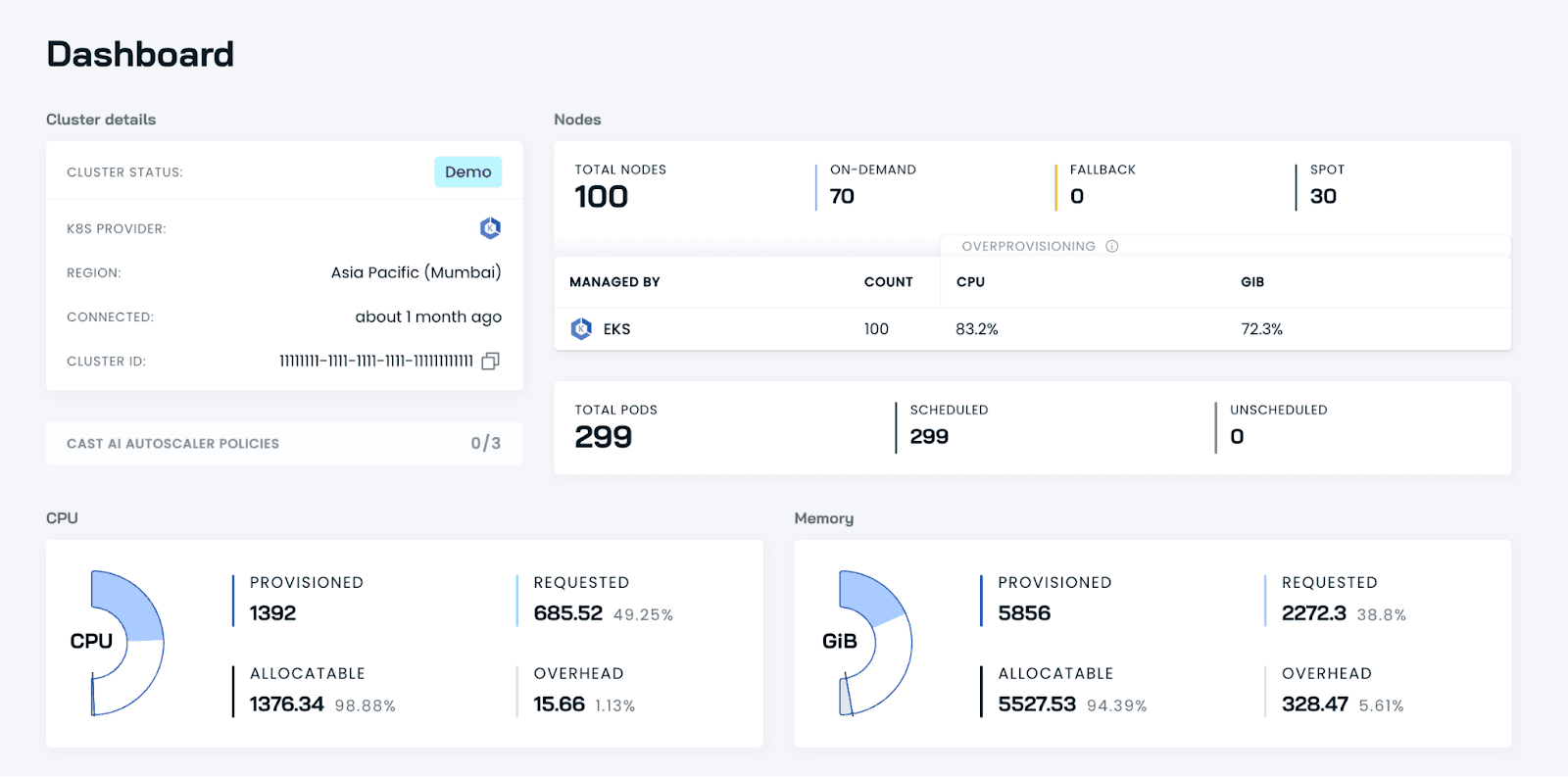
Best for: Teams whose biggest waste is at the node and instance layer.
Cast AI is one of the longer-standing names in this space. Its core approach automates node provisioning and pod scheduling, analyzing real-time cluster data to decide when to scale up, scale down, or rebalance onto cheaper instances.
It has strong spot instance management, automated fallback logic, and broad cloud coverage. Its own reporting cites 50 to 75 percent savings at large customers, drawn from data measured across tens of thousands of production clusters.
The thing to watch is that its live migration is limited and constrained. It requires Kubernetes 1.30-plus, specific container runtimes, and is optimized primarily within particular cloud provider setups.
If your pain is pod-level rightsizing on stateful workloads, that is not Cast AI's center of gravity.
Strengths
- Established platform with broad cloud provider coverage
- Strong spot instance management and automated fallback
- Clear cost visibility and reporting
Trade-offs
- Node-focused, so pod-level rightsizing on stateful workloads is not the priority
- Live migration has version and runtime constraints
4. StormForge (CloudBolt)#
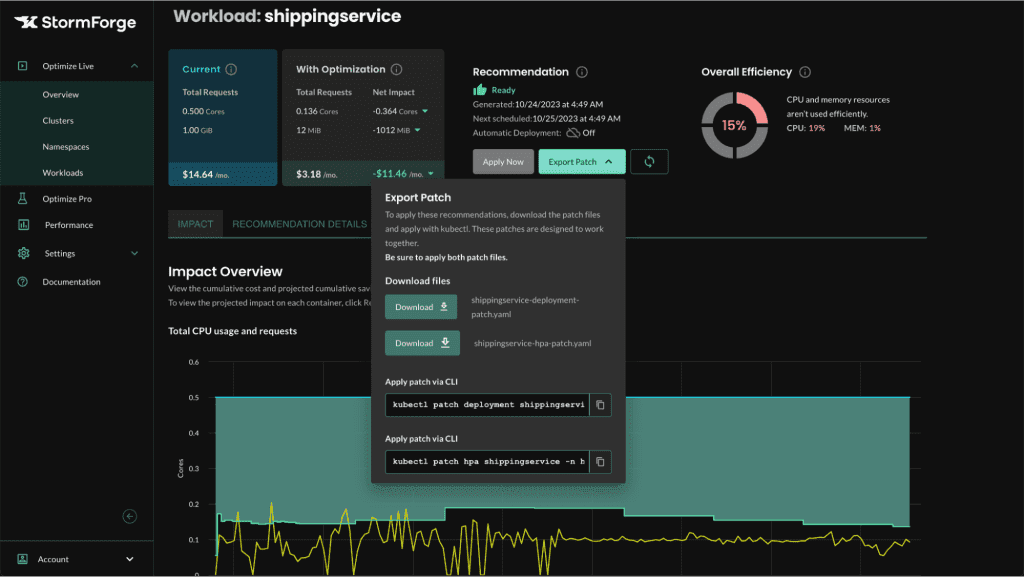
Best for: Enterprises that want vertical rightsizing and HPA to cooperate instead of collide.
StormForge, now part of CloudBolt after a 2024 acquisition, uses forecast-based machine learning to recommend CPU and memory requests and limits.
Its signature move directly addresses one of VPA's worst habits. Instead of fighting HPA, StormForge adjusts resource requests and recalculates HPA target utilization together, as one atomic change, so vertical and horizontal scaling stay in sync.
It reports 40 to 60 percent savings from reducing waste. It also gives you rollout control for the in-place-resize era: resize in place, fall back to a controlled restart only when the kernel cannot accommodate the change, or defer to the next natural deployment.
Strengths
- Forecast-based ML that handles noisy, seasonal workloads
- Harmonizes vertical rightsizing with HPA in one change
- Flexible in-place rollout with controlled fallback
Trade-offs
- Focused on the pod layer, so the node and instance strategy sits outside its scope
- Commercial-only, enterprise licensing
5. PerfectScale (DoiT)#
Best for: Teams where production stability matters as much as the savings.
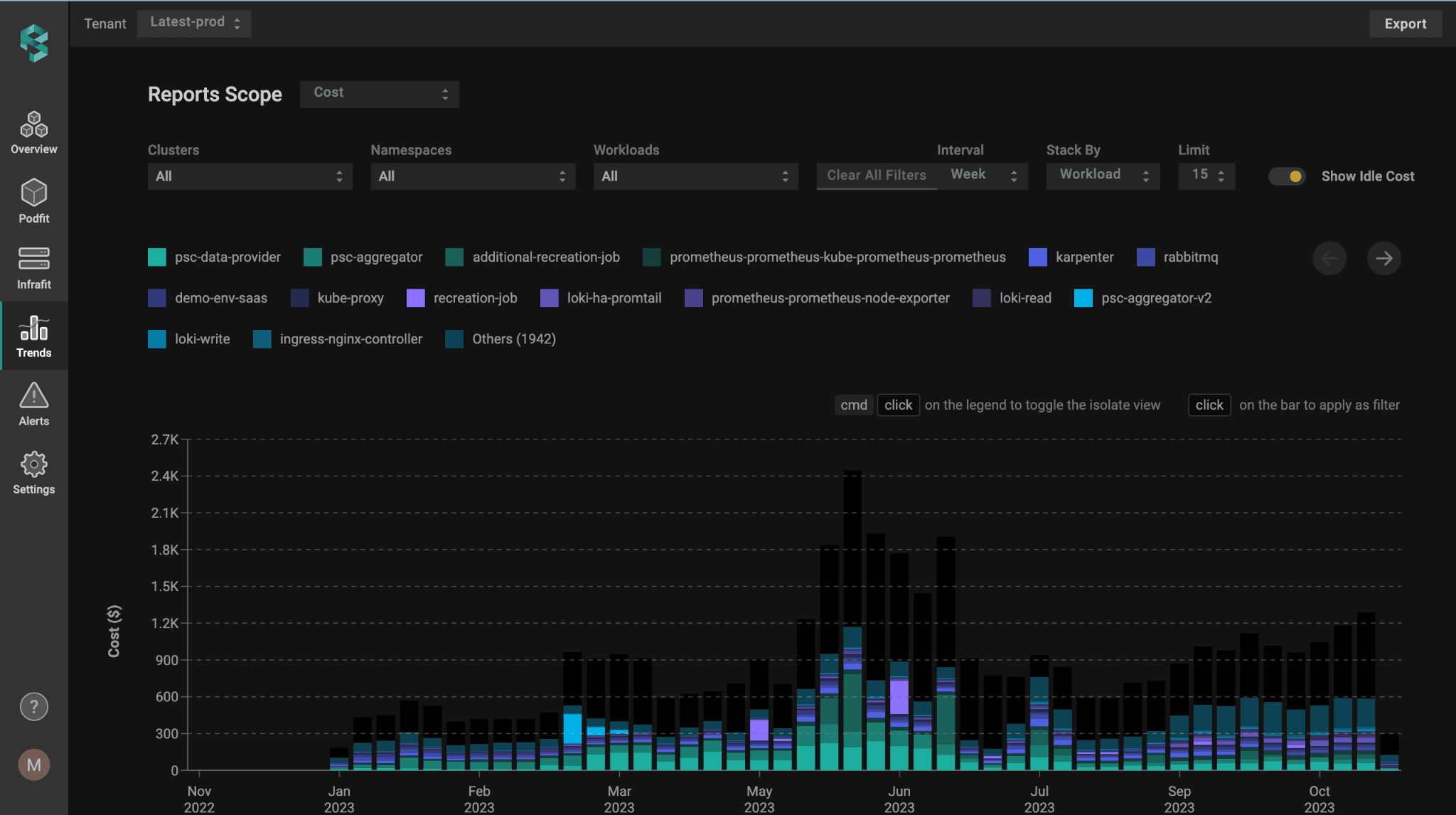
PerfectScale, acquired by DoiT International, sits at the intersection of cost efficiency and reliability. It adjusts resource requests and limits to cut waste while also flagging reliability risks, such as containers that are under-resourced relative to how they actually behave.
Its bin-packing recommendations tend to be conservative and better calibrated for production, which is a useful counterweight to tools that optimize purely for cost and leave you with a fragile setup. It runs a lightweight agent inside the cluster and reports savings within days.
Strengths
- Reliability-aware optimization that flags downtime risk
- Conservative, production-calibrated bin-packing
- Integrates with existing tooling without major workflow changes
Trade-offs
- No live migration or checkpoint-restore
- Node lifecycle and multi-cloud provisioning are not primary strengths
6. Sedai#
Best for: Teams running mixed infrastructure that want cautious, self-driving automation.
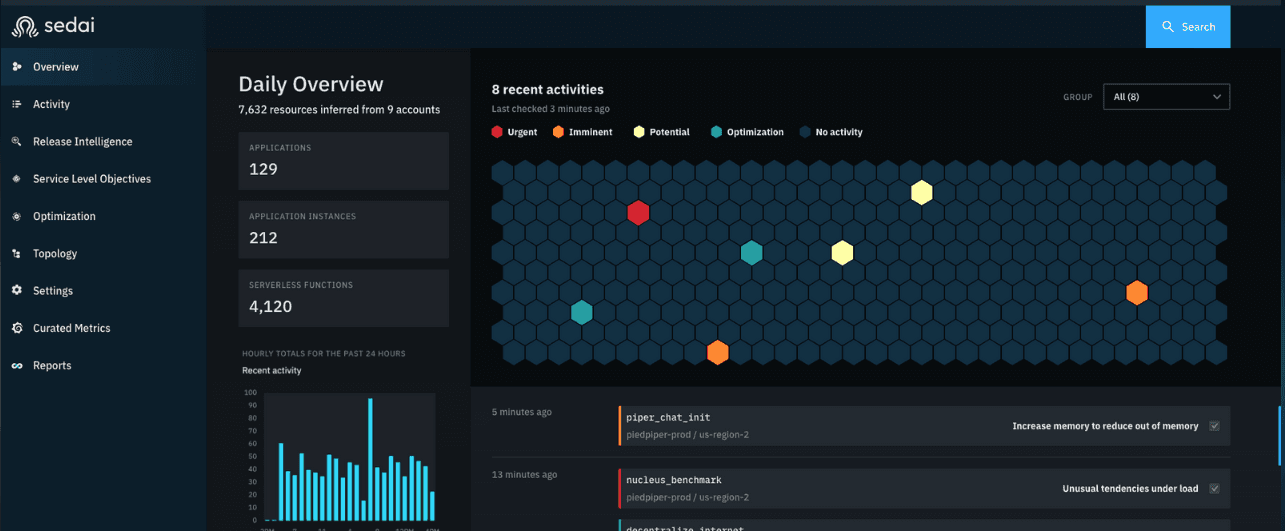
Sedai distinguishes itself with caution. Rather than making aggressive changes, it uses AI to model the risk of each optimization action before executing it, learning from historical performance and applying changes conservatively.
It also reaches beyond Kubernetes into serverless and general cloud resources, which suits teams managing heterogeneous infrastructure.
Strengths
- Risk-aware automation that lowers the chance of reliability issues
- Broader coverage beyond Kubernetes for mixed environments
- Learns workload-specific patterns over time
Trade-offs
- The cautious approach can mean slower or smaller savings
- Kubernetes-specific depth in rightsizing and bin-packing is shallower than dedicated tools
- No checkpoint-restore or live migration
What actually makes a good VPA alternative for production?#
Before the list, here is the scorecard. These are the factors that separate a tool you can trust with a production cluster from one that just prints recommendations.
| Factor | Why it matters in production |
|---|---|
| Applies changes without disruption | A recommendation you cannot safely apply is worthless. Look for in-place resize or live migration, not evict-and-recreate. |
| Works with HPA, KEDA, and Karpenter | A VPA replacement should complement your existing autoscalers, not force you to rip them out. |
| Cost-aware, not just usage-aware | The tool should connect every resource change to node bin-packing and your actual cloud bill. |
| Handles stateful and GPU workloads | Databases, JVM services, and ML jobs are where restarts hurt most, so this is the real test. |
| Read-only, low-risk install | You should be able to see the savings before you let anything go to production. |
Keep that scorecard in mind as you read. It is the difference between a tool that saves money on a slide and one that saves money on the invoice.
How to choose the right one for your cluster#
Pick based on where your waste actually lives, not on which tool has the flashiest dashboard. A quick way to decide:
- If restarts are the reason you never applied VPA, and you run stateful services, databases, or GPU jobs, start with DevZero. Live rightsizing plus checkpoint-restore is the direct answer to the restart problem, and the read-only install lets you prove it on one cluster first.
- If you want hands-off pod rightsizing with little configuration, look at ScaleOps or PerfectScale.
- If your bleed is at the node and instance layer with heavy spot usage, Cast AI is proven there.
- If you need vertical rightsizing and HPA to stop fighting each other at enterprise scale, StormForge is built around that.
- If you manage mixed infrastructure and want cautious automation, Sedai fits.
One practical note for everyone: Before you let any tool write to production, run it in read-only or recommendation mode for a week and capture a baseline.
Compare your cluster's CPU and memory utilization against the 2026 benchmarks, where average CPU utilization sits near 8 to 10 percent and memory near 20 percent, which means most clusters pay for five to twelve times the compute they use.
That baseline tells you how big your opportunity is before you spend a cent.
Why DevZero is the strongest fit for production VPA replacement#
If you strip this down to the one question that matters, it is this: can the tool safely apply the change on a live production workload? That is exactly where native VPA fell short for years, and it is where DevZero is built to win.
VPA shows you what to fix. DevZero makes the fix actionable, safe, and continuous. It rightsizes CPU and memory on running pods with no eviction, it migrates workloads across nodes with checkpoint-restore so nothing restarts, and it ties every resource decision to your real cloud bill so the savings show up on the invoice, not just the slide. For an AI training run or a stateful production service, the migration story becomes the deciding factor because an unexpected restart can mean hours of lost work.
The proof is in the install experience. DevZero's operator is read-only, so it writes nothing to production on day one. You get real utilization metrics, cost breakdowns by team and project, and specific recommendations within hours, then you decide when to apply them.
Personality Pool went from 15 percent utilization and unpredictable AWS bills to a 60 percent cost reduction in 30 days this way, with a 30 percent daily spend drop inside the first 24 hours.
Here is what that means for you: You stop paying for compute you never use. And you can approve new initiatives knowing costs will scale with usage, not with a nervous provisioning decision made in the dark.
Most clusters are overprovisioned. The fastest way to find out how much you're wasting is to look. Install the read-only operator on one cluster and see your potential savings in 24 hours, or book a demo to watch a live workload get resized without a restart.
Frequently Asked Questions#
What are the best Kubernetes VPA alternatives for production?#
The strongest VPA alternatives for production combine continuous, disruption-free rightsizing with cost awareness — options include DevZero, ScaleOps, Cast AI, StormForge, PerfectScale, and Sedai. They differ in how they apply changes (live vs. restart-based), GPU workload support, and how tightly they integrate with HPA.
Why do teams look for alternatives to native Kubernetes VPA?#
Native VPA typically requires pod restarts to apply changes, has no cost dimension to its recommendations, and struggles with bursty workloads. Teams running production-critical services often need zero-disruption rightsizing and cost-aware recommendations that VPA alone doesn't provide.
Is native VPA still worth using in 2026?#
For recommendation-only mode, it can still be a useful advisor, especially in dev and staging. With Kubernetes v1.35, in-place pod resize is stable, and VPA's InPlaceOrRecreate mode reduces restart pain, but it's still in beta and falls back to eviction when a node lacks capacity. For production automation on stateful or GPU workloads, a purpose-built alternative is safer.
Does in-place pod resize replace the need for a VPA alternative?#
No. In-place resize removed the restart requirement at the platform level, but it did not add cost awareness, latency signals, scheduling intelligence, or safe cross-node migration. VPA still only reads CPU and memory history. The tools in this guide add the parts VPA lacks.
Do Kubernetes VPA alternatives require pod restarts?#
It depends on the tool. Some, like DevZero, apply resource changes live without restarting pods. Others still rely on eviction-and-recreate cycles similar to VPA's own Auto mode, so it's worth confirming a tool's update mechanism before adopting it for latency-sensitive workloads.
Can I run a VPA alternative alongside HPA and Karpenter?#
Yes. The strongest tools are designed to complement HPA, KEDA, and Karpenter rather than replace them. DevZero, for example, fills the workload-level layer that those tools do not cover and works alongside them.
Which VPA alternative works best alongside HPA?#
Tools that separate vertical rightsizing decisions from horizontal scaling signals tend to avoid the conflicts that occur when VPA and HPA both react to CPU usage. Look for a tool that explicitly documents HPA compatibility rather than assuming it.
What savings are realistic?#
Independent 2026 reporting puts automated rightsizing at roughly half of the provisioned CPU, and full platforms report 40 to 75 percent total savings. DevZero reports 30 to 60 percent compute reduction, and one customer reached 60 percent in 30 days.
Which tool is safest for stateful workloads like databases?#
Anything that avoids restarts. Look for live in-place resize and, ideally, live migration. DevZero's checkpoint-restore is the only option in this list that moves a running workload without restarting it, which is the hardest case for databases and JVM services.
What are the alternatives to ScaleOps for automated pod rightsizing?#
DevZero, Cast AI, StormForge, PerfectScale, and Sedai are the main alternatives to ScaleOps for automated cluster and pod rightsizing, each with different trade-offs around live updates, GPU workload support, and pricing model.
DevZero Team


